

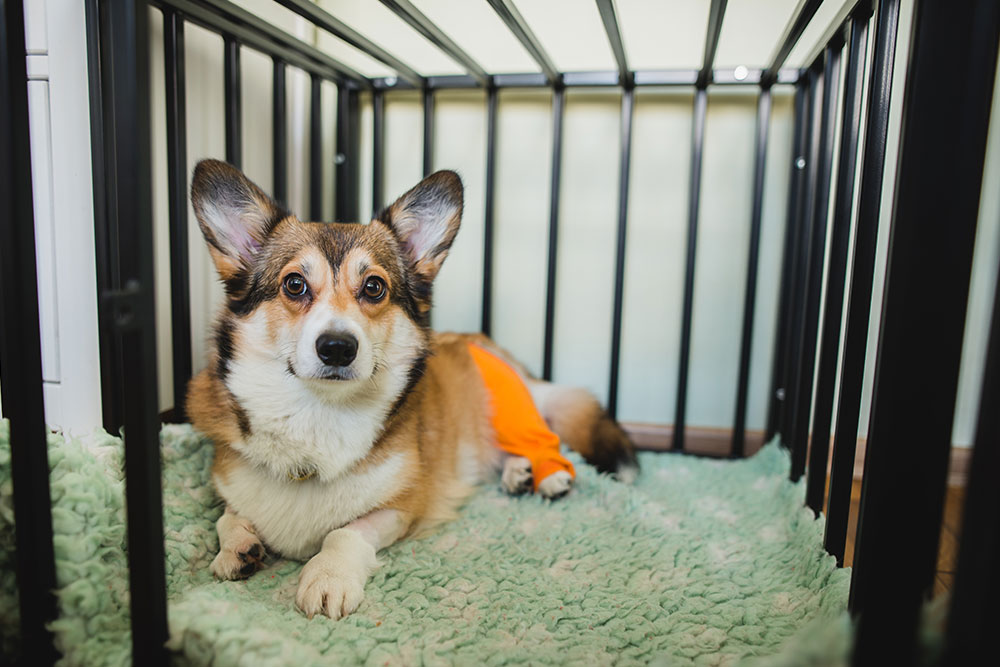
If your dog suddenly starts limping on a back leg, especially after running, jumping, or an awkward landing, a cranial cruciate ligament (CCL) tear is one of the first things we consider. The CCL is a tough band of tissue inside the knee that prevents the shin bone from sliding forward under the thigh bone. When it tears, the knee loses stability, and every step your dog takes grinds the joint surfaces together in ways they were not designed for. Without treatment, that instability leads to chronic pain, progressive arthritis, and damage to the meniscus (the cartilage cushion inside the knee).
At Greenfield Veterinary Clinic, we see CCL injuries regularly, particularly in larger breeds. We use our in-house diagnostics to confirm the injury, walk you through the surgical options that exist, help you decide which one fits your dog best, and are with you through every stage of recovery. If your dog has been limping or showing stiffness in a hind leg, contact us or call 414-282-5230 to schedule an evaluation.
Understanding the CCL: What It Does and Why Tears Are So Common
Anatomy, Causes, and Who Is at Risk
The cranial cruciate ligament is the primary stabilizer of the canine knee, preventing the tibia from sliding forward under the femur during movement. A canine cruciate ligament injury disrupts that stability, and the consequences compound with every step taken on the compromised joint.
Most CCL tears in dogs are not the result of a single dramatic injury the way human ACL tears often are. Instead, gradual ligament degeneration creates a structure that is already compromised before a final moment of awkward movement completes the tear. This is why the injury can seem to come out of nowhere: your dog was apparently fine until they were not.
Factors that increase CCL injury risk:
- Abrupt pivoting, twisting, or sudden directional changes during play, especially on unpredictable surfaces like icy Wisconsin sidewalks or uneven yards
- Weekend-warrior activity patterns where a dog that rests most of the week suddenly runs hard
- Excess body weight, which amplifies the load on the knee with every step
- Breed predisposition: Labrador Retrievers, Rottweilers, Golden Retrievers, and Boxers carry higher baseline risk due to their knee geometry, and large breeds in general face greater CCL vulnerability than small ones
- A prior partial tear that was not identified and progressively worsened
Large breed dogs in particular deserve early attention when hind limb symptoms develop. Our team approaches these cases with the knowledge that bigger dogs have different needs, different biomechanics, and different recovery timelines than smaller patients. Our wellness and preventive care includes body condition assessments and weight management guidance that reduce long-term joint stress for at-risk breeds.
Recognizing the Signs of a CCL Tear
When Limping Is More Than Limping
Some CCL tears are obvious: a dog suddenly refuses to bear weight on a hind leg, and it is clear something significant has happened. Others develop slowly, with a hind-limb limping pattern that improves with rest and worsens with activity. Both patterns are worth taking seriously.
Signs that suggest a CCL injury rather than minor soreness:
- Hind-leg lameness that worsens noticeably after walks, play, or exercise
- Brief improvement with rest, followed by return of the limp when activity resumes
- Visible swelling along the inside of the knee that does not resolve
- Sitting with the affected leg held out to the side
- Reluctance to jump, climb stairs, or rise from resting
- A toe-touching gait where the foot barely makes contact with the ground
The important distinction: sprains and minor soft tissue injuries typically improve meaningfully within a week of rest. CCL tears do not. If the limp is still present or recurring after a week, evaluation is the right next step rather than extended waiting.
Confirming the Diagnosis
Examination and Imaging
Diagnosis combines a hands-on orthopedic exam with imaging. The drawer sign and tibial thrust test detect how much the tibia slides relative to the femur when pressure is applied, confirming ligament instability. Some dogs need light sedation for these tests to be accurate, particularly when they are painful or tense.
X-ray diagnostic imaging assesses secondary joint changes: fluid accumulation, early arthritis, and bone remodeling that can indicate how long instability has been present, and rules out fractures or other bony contributors. In complex presentations, MRI provides detailed soft tissue imaging when standard assessment leaves questions unanswered.
Our in-house diagnostics include orthopedic assessments with digital radiography and ultrasound, which lets us complete the initial workup efficiently and without sending you somewhere else to get answers.
Why Rest Alone Will Not Fix This
This question comes up at almost every CCL evaluation, and it deserves a direct answer. The short version: no, rest alone does not allow a CCL tear to heal.
The torn ligament does not regenerate in a way that restores mechanical stability. Without that stability, the joint moves abnormally with every step. That abnormal movement causes arthritis to develop rapidly, erodes the cartilage, and puts the meniscus at serious risk of tearing from the repetitive abnormal loading.
Rest reduces pain temporarily by reducing the frequency of harmful joint movement, but the underlying problem persists. Dogs managed without surgery tend to progressively worsen as arthritis accumulates, and by the time surgery is eventually pursued, the joint is in significantly worse condition than it would have been with earlier intervention.
If your dog is limping, the kindest thing you can do for their long-term joint health is get them evaluated promptly rather than waiting to see if it improves. Reach out to our team and we will help you understand where things stand.
Conservative Management: Honest Guidance
For very small dogs (typically under 15 pounds), conservative management with strict rest and controlled activity gives some patients a reasonable chance of functional stabilization through fibrous tissue formation over several months.
For medium, large, and giant breed dogs, the evidence is consistent and clear: surgery produces meaningfully better long-term outcomes. The joint does not stabilize adequately with rest at larger body sizes, and arthritis progresses regardless. This is not meant to pressure anyone into surgery; it is meant to ensure that the decision is made with accurate information rather than optimism that the outcome will be different.
If you have questions about which approach is appropriate for your dog’s size, age, or health status, request an appointment and we will work through the specifics together.
Surgical Options: TPLO, TTA, and Extracapsular Repair
Which Procedure Is Right for Your Dog?
Surgery restores mechanical stability to the knee and slows the progression of arthritis. There are three main procedures used in dogs today, and the right one depends on your dog’s size, activity level, age, and overall health. At Greenfield, we work through the options with you in detail and help you understand which approach we would recommend for your specific dog.
TPLO (Tibial Plateau Leveling Osteotomy)
TPLO surgery modifies the geometry of the tibial plateau so that normal walking forces no longer cause the forward sliding that the CCL was preventing. The bone is cut, repositioned, and secured with a plate while healing occurs. TPLO is the most widely recommended approach for active dogs and medium to large breeds because of its consistently strong long-term functional outcomes.
TTA (Tibial Tuberosity Advancement)
TTA advances the tibial tuberosity to redirect the mechanical forces acting on the knee. It is used in active and medium to large breed dogs and produces outcomes comparable to TPLO in appropriate candidates.
Extracapsular Repair (Lateral Suture)
A strong synthetic suture placed outside the joint mimics the CCL’s stabilizing function while fibrous tissue develops. This is best suited to smaller or less active dogs and patients where bone-modifying surgery is not appropriate. Long-term durability in larger or highly active dogs is generally lower than TPLO or TTA.
| Procedure | Best Suited For | Long-Term Outlook |
| TPLO | Active dogs, medium to large breeds | Excellent; gold standard for larger dogs |
| TTA | Active dogs, medium to large breeds | Excellent; comparable to TPLO in right candidates |
| Extracapsular repair | Small or less active dogs | Good for appropriate patients; less durable in large breeds |
What Recovery Actually Looks Like
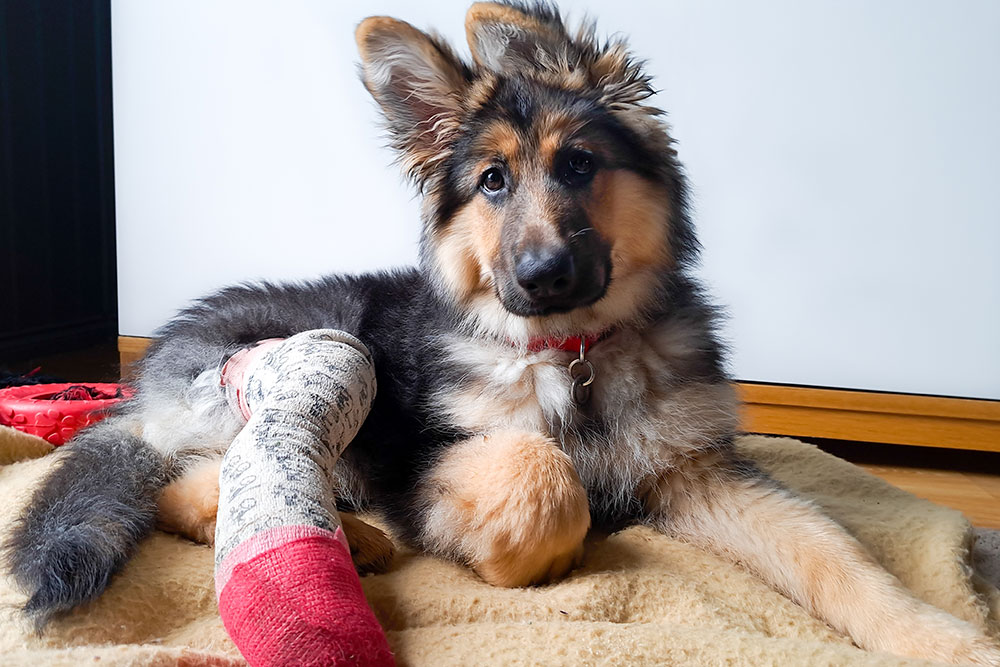
Rehabilitation is the second half of the treatment. Rehabilitation therapies including controlled leash walking, hydrotherapy, therapeutic exercises, and targeted physical therapy rebuild muscle, restore range of motion, and protect the repair during healing.
General recovery milestones:
| Period | Activity Guidelines |
| Weeks 1-2 | Crate or pen rest; leash only for bathroom breaks; incision check |
| Weeks 3-4 | Short, slow leash walks beginning; gradual duration increase |
| Weeks 5-7 | Progressively longer leash walks; no running or jumping |
| Week 8+ | Recheck evaluation; off-leash activity discussed if healing confirmed |
No unsupervised activity during recovery. The cone (e-collar) stays on until the incision is healed and your dog is cleared by their medical team. These are not loose guidelines; they are the parameters that protect the repair during the critical healing window.
Managing Crate Rest at Home
Honest advice: crate rest with an active or high-energy dog is one of the more challenging parts of CCL recovery for many families. Having a strategy helps.
Practical tips for getting through it:
- Keep the crate in the main living area so your dog does not feel isolated from the household
- Use food puzzles and stuffed enrichment toys to provide mental engagement without physical activity
- Take slow, short leash sniff walks to provide sensory stimulation without joint stress
- Keep a predictable daily routine so your dog knows what to expect
- Ask our team about calming support options if anxiety becomes a barrier to safe recovery
Surviving crate rest with your dog genuinely gets easier once you have systems in place. The first two weeks are the hardest and also the most critical; protecting the repair during that window pays off in the months that follow.
Protecting the Joint for the Long Term
Daily Habits That Matter
Warm-ups and cooldowns before and after activity should be part of your dog’s permanent routine, not just during recovery. A five-minute slow walk before any exercise session prepares the joint for what is coming. Non-slip mats on hard floors, careful management of stairs, and avoiding sharp directional changes on slippery surfaces all reduce load on the healing and operated-on leg.
Weight control is one of the most impactful things you can do for joint longevity. Every pound above ideal body weight adds stress to the repaired knee, accelerates arthritis, and raises the statistical risk of injury to the opposite leg, which tears in a meaningful percentage of dogs within two years of the first injury. For large breeds, where body weight is already significant, keeping weight in an optimal range is especially consequential.
Frequently Asked Questions
Can my dog fully recover after CCL surgery?
For most dogs, yes. Return to full or near-full function is the expected outcome for appropriately selected patients who complete structured recovery. The timeline varies by procedure, dog size, and how promptly treatment was pursued, but most dogs are on their way to normal activity by the 3 to 4 month mark.
How do I know if the other leg is at risk?
There is no reliable way to predict which dogs will injure the opposite CCL, but a large percentage of dogs will rupture their other CCL within a year of the first. The best protective measures are maintaining a healthy weight, consistent exercise conditioning, and appropriate activity progression after the first surgery.
Will my dog need pain management long-term?
Many dogs benefit from ongoing joint supplement support, and only some will need long-term pain medications. This is something we evaluate at follow-up visits based on how the joint has healed and how your dog is moving. Many dogs do well without long-term medication after full recovery.
Is CCL surgery an emergency?
Not typically in the immediate sense. A limping dog that is stable can generally be scheduled rather than rushed in. That said, delaying evaluation by weeks or months allows arthritis to accumulate, so scheduling promptly is in your dog’s best interest.
Getting Your Dog Back on Four Legs
CCL tears are common, treatable, and survivable with the right plan. The dogs that do best are the ones whose families recognize the problem early, get a confirmed diagnosis, and commit to a surgical and recovery plan that matches the individual dog. At Greenfield Veterinary Clinic, we bring the depth of experience that comes from working with large breeds in a community where active dogs are everywhere, and we stay involved from diagnosis through full recovery. We will take care of your dog like family, because that is exactly what they are to you.
If your dog has been limping or showing any of the signs above, contact our team at 414-282-5230 or request an appointment and let’s get to the bottom of it.



Leave A Comment