

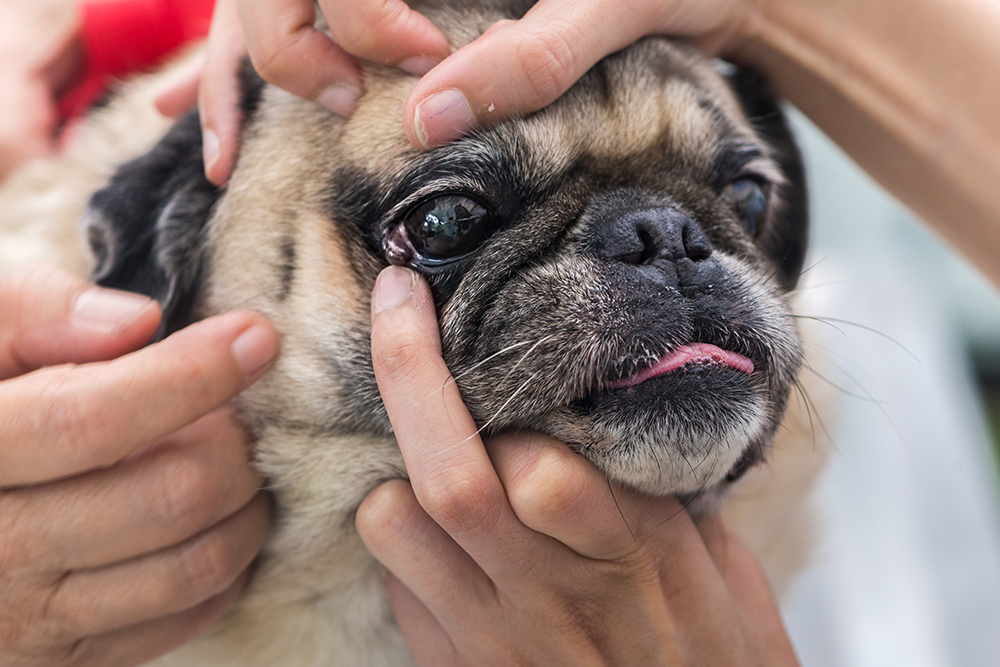
Some breeds really are born with facial and eyelid anatomy that makes entropion and ectropion far more likely than in the average dog. The shape of the skull, the depth of the facial folds, and the looseness of the skin around the eye all decide how the lids sit, and certain breeds inherit a setup that pulls a lid inward or lets it droop outward. Flat-faced and heavy-folded breeds tend toward entropion, where the lid rolls in and lashes rub the eye, while loose-lidded breeds tend toward ectropion, where the lower lid sags and leaves the surface exposed. Cats can develop both, though it is less about breed and more often the result of chronic inflammation or scarring.
At Greenfield Veterinary Clinic, our experienced surgeons correct eyelid problems in-house, including CO2 laser surgery that reduces bleeding and shortens recovery compared with traditional techniques. We tailor the plan to the individual pet, from a giant breed to a toy breed, rather than sending these cases elsewhere. If your dog or cat has been squinting, rubbing at an eye, or showing persistent discharge, get in touch and we will schedule an exam to see exactly what is going on.
What to Know If Your Breed Is at Risk
- Anatomy drives the risk: facial shape and skin looseness decide how the lids sit.
- The split follows the build: flat-faced and folded breeds roll in, droopy-lidded breeds sag out.
- Predisposed does not mean doomed: early monitoring catches changes before the cornea is damaged.
- Correction happens here: experienced in-house surgeons handle these cases, often with laser.
Why Does Breed Determine Eyelid Risk?
Breed shapes the eyelids because it shapes the whole face. Entropion develops when a lid rolls inward and the lashes scrape the cornea, and ectropion when the lower lid droops outward and exposes the inner tissue. Which one a dog is prone to follows directly from its inherited build: the skull shape, the facial folds, and how loose the skin sits around the eye.
That is why these are considered conformational conditions, since the same features bred for a certain look also set the lids slightly off. A flat face with prominent eyes invites entropion, while a heavy, loose-skinned head invites a sagging lower lid. Several eyelid disorders can even appear together in one dog, which is common in the breeds carrying the most extreme facial structure.
Which Breeds Carry the Highest Risk?
Matching the build to the condition shows the pattern clearly.
| Breed group | Why they are at risk | Condition |
| Flat-faced dogs (Bulldogs, Pugs, Boxers) | Compressed face, prominent eyes | Entropion |
| Heavy-folded dogs (Shar-Peis, Chow Chows) | Deep folds weigh or push on the lids | Entropion |
| Large loose-skinned dogs (Mastiffs, Rottweilers) | Loose facial skin | Entropion |
| Droopy-lidded dogs (Bloodhounds, Basset Hounds) | Naturally loose lower lids | Ectropion |
| Giant breeds (Saint Bernards, Newfoundlands) | Heavy lids and loose skin | Often both |
| Flat-faced cats (Persians, Himalayans) | Short-faced anatomy | Entropion |
The table covers the most affected breeds, but any dog with a similar build can be affected, and a mixed-breed dog can inherit the risk along with the look.
What Else Raises the Risk Beyond Breed?
Breed sets the baseline, but it is not the whole story. Eyelid problems can also develop or worsen from age-related tissue relaxation, chronic inflammation or infection, previous eye trauma, scarring from earlier surgery, weight loss that changes the support around the eye socket, and even pain-induced squinting that gradually retrains a lid into a rolled position. An at-risk breed that also picks up one of these is especially likely to show problems, which is why a known predisposition is worth keeping on the radar.
Does Breeding Play a Role in Eyelid Risk?
Because entropion and ectropion are largely inherited, breeding choices shape how often they show up. Responsible breeders of at-risk breeds screen their dogs for eyelid conformation and avoid breeding individuals with significant lid problems, which gradually lowers the risk in their lines. For a family choosing a puppy from a predisposed breed, that history matters, and asking whether the parents have had eyelid issues or corrective surgery is a fair and useful question. A puppy from screened, clear-eyed parents is not guaranteed to be unaffected, since growth and environment still play a part, but the odds are better. It is also worth knowing that some breed registries have rules about whether a dog with surgically corrected eyelids can be shown, which is a separate consideration from the medical one.
How Do You Spot It Early in an At-Risk Breed?
Catching it early in a predisposed dog comes down to watching for the signs of eye pain, which pets rarely show openly. Persistent squinting, tearing or eye discharge, pawing at the face, redness, a cloudy cornea, or light sensitivity all warrant a look. Left alone, entropion grinds toward corneal ulcers, scarring, and vision loss, while ectropion brings recurrent conjunctivitis and dry eye. The earlier a change is caught in a high-risk breed, the simpler the fix. We’ll also evaluate your pet’s eyelids at the first puppy visits and every annual wellness exam thereafter so we can catch problems earlier.
How Is It Diagnosed?
Diagnosing entropion or ectropion is mostly a hands-on exam, with a few specific tests that decide how to plan the repair.
We start by watching how the lids sit at rest and during blinking, then gently manipulating the lid to see how it lies when the lashes aren’t actively pulling against the surface. We also check for misdirected lashes growing from the lid margin (distichia) and for ectopic cilia growing through the inner lid, both of which can drive the same signs as entropion and sometimes coexist with it.
A topical anesthetic drop is part of the workup for a reason. A pet with a painful eye often squints hard, and that squinting alone can roll a lid inward and mimic structural entropion. If the lid sits normally once the pain is gone, we need to find what is hurting before doing anything to the lid. If it stays rolled in, the entropion is structural and surgery is the right answer.
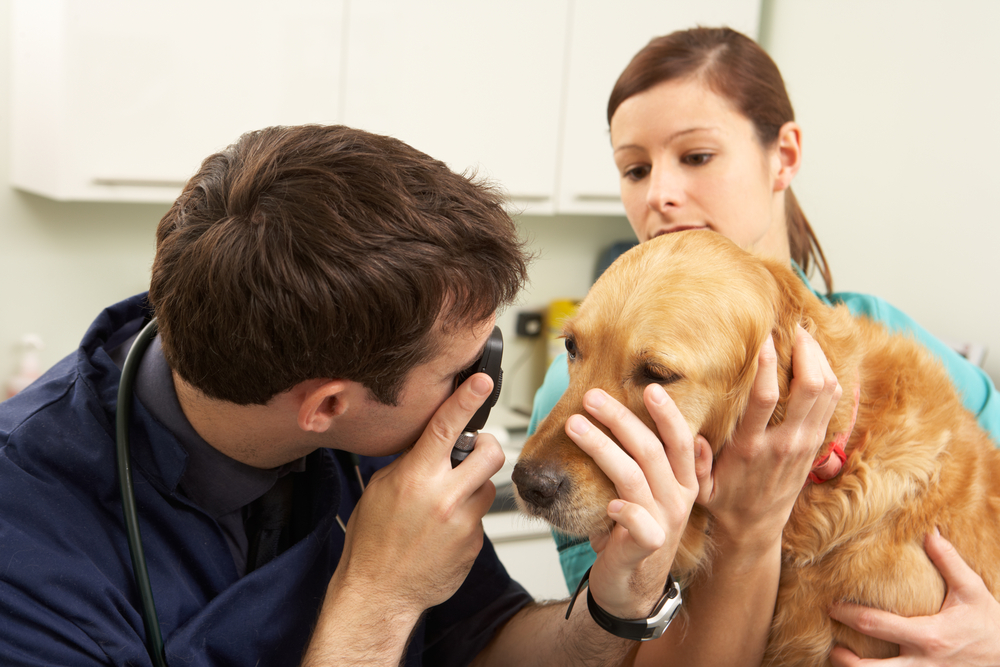
A Schirmer tear test measures tear production, since chronic surface irritation can reduce it over time, and treating only the lid without addressing dry eye doesn’t give the cornea what it needs to heal. Fluorescein staining lights up any break in the corneal surface under blue light, telling us how much active damage has already happened. Our in-house diagnostics cover all of these at the same visit, so most cases are fully worked up in a single appointment.
How Is It Corrected?
The technique depends on the pet’s age and the severity of the lid malposition.
For young dogs whose faces are still maturing, temporary eyelid tacking uses small sutures to pull the lid outward while the face finishes growing. Some puppies grow out of mild entropion entirely with tacking alone; others go on to definitive surgery later, but in the meantime their corneas are spared from chronic damage during the most vulnerable period. Tacking is also useful in adult pets with painful eyes where ongoing squinting is rolling the lid further inward.
For adult dogs and cats with structural entropion or ectropion, definitive eyelid surgery repositions the lid by removing a precise amount of skin and underlying tissue. The amount removed has to be calculated carefully, since too little leaves residual rolling and too much overcorrects into the opposite problem. Severe cases in giant breeds with multiple deformities sometimes need more complex combination repairs, which are still handled in-house.
Our use of CO2 laser surgery matters for surgery this close to the eye. The laser seals small blood vessels as it cuts, which reduces bleeding and improves visibility during the procedure, and there’s less tissue trauma, less swelling, and a more comfortable recovery afterward. Most pets go home the same day with pain control included in the protocol.
What Happens If I Don’t Treat It?
Untreated entropion and ectropion don’t stay still. The friction or exposure keeps working on the corneal surface day after day, and the consequences accumulate predictably.
The cornea isn’t built to withstand repeated rubbing from lashes or chronic exposure to air. Mild entropion produces a constant low-grade irritation that the pet adapts to but the cornea doesn’t. Over weeks and months, the surface develops erosions, then visible ulcers, then deeper ulcers that can perforate the cornea, which is a true emergency requiring urgent surgery to save the eye. Chronic irritation also triggers the eye’s repair mechanisms, including pigmentary keratitis, the deposition of brown pigment that gradually spreads across the surface. Once the pigment is laid down, it doesn’t go away on its own, and dense pigment can permanently obscure vision even after the underlying lid problem is corrected.
The pain piece catches families off guard. Dogs and cats adapt to chronic eye pain in ways that hide it from us. They squint, they tear, they paw at the eye occasionally, but they also go on eating, playing, and acting mostly normal. After surgical correction, families regularly tell us “she’s so much more her old self” and realize, in retrospect, how much daily discomfort they had stopped noticing.
Is It Different in Cats?
Cats follow a different pattern. Entropion in cats tends to appear later in life and usually ties to chronic surface problems, such as conjunctivitis or herpes-related corneal disease, rather than breed-specific build. They sometimes need a blend of techniques, and any underlying viral disease has to be managed alongside the lid repair.
What Does Recovery Involve?
Recovery is usually straightforward. Most pets are visibly more comfortable within a few days, with mild swelling and a little pinkish discharge that fade over the first week or two. An Elizabethan collar stays on until the recheck, since one hard rub can undo the repair, and we will coach you through administering eye medications so the drops are less of a battle.
A few practical notes on the recovery period:
- Activity restriction for the first 10 to 14 days. No rough play, no swimming, and ideally no head-shaking-inducing situations.
- Watch the incision daily for swelling, discharge, or any opening. Some pink-tinged discharge is normal; bright red bleeding is not.
- Keep eye medications on schedule. The drops are doing real work; missed doses slow healing.
- Don’t let your pet sleep with their face buried in soft bedding for the first few days, since that can produce friction on the incision.
- A suture-removal recheck around day ten confirms the lid is sitting where it should.
Beyond the recheck, most pets need no further surgical follow-up. We’ll see them at their next wellness visit and confirm the long-term result, but for the majority of cases, one surgery is the whole story.
Frequently Asked Questions About Breed Risk and Eyelid Surgery
Will My At-Risk Breed Definitely Develop an Eyelid Problem?
Not necessarily. Predisposition raises the odds, but plenty of dogs in high-risk breeds never need surgery. The smart move is monitoring for early signs at every wellness visit, so any change is caught while the fix is simple.
Can Entropion Go Away on Its Own?
In growing puppies, mild entropion sometimes resolves as the face matures, and temporary tacking holds the lid steady in the meantime. In adult dogs and cats, a structural lid problem does not self-correct and tends to worsen as the friction reshapes the lid further.
Will My Pet Need Surgery on Both Eyes?
Often, when both eyes are affected, though not always on the same day. We usually correct one eye at a time so the other stays comfortable during recovery, scheduling the second once the first is healing well. In some cases, both eyes can be done under the same anesthesia when the changes are mild and symmetric.
How Long Does the Surgical Repair Last?
For mature pets with definitive surgery, the result is typically permanent. Some dogs need a small revision down the line if the original correction was overly conservative, and pets whose lid problems were part of a progressive condition can develop new changes as they age, but redo surgery is the exception rather than the rule.
Is the Surgery Painful for My Pet?
The surgery itself is performed under general anesthesia, so there’s no pain during the procedure. Post-operative pain is managed with medication, and most pets are visibly more comfortable within a few days as the original chronic irritation resolves. The relief from the underlying lid problem usually outweighs the temporary post-surgical discomfort within the first week.
I Am Getting an At-Risk Breed. What Should I Ask?
Ask the breeder whether either parent has had entropion, ectropion, or eyelid surgery, and whether the line carries a history of eye problems. Once your puppy is home, flag the breed risk at the first checkup so we can set a baseline and watch the lids as the face matures. Early awareness turns a possible surprise later into something already on the radar.
A Path to Comfort for At-Risk Breeds
Being born predisposed does not mean a dog is destined for eye damage. With timely evaluation, the breeds most prone to entropion and ectropion can have a problem caught and corrected before the cornea suffers, and the surgery succeeds in the large majority of cases.
If your dog or cat has been squinting, tearing, or rubbing at an eye, or your breed sits on the higher-risk list and you want a baseline check, request an appointment or contact us and we will take a careful look.


Leave A Comment